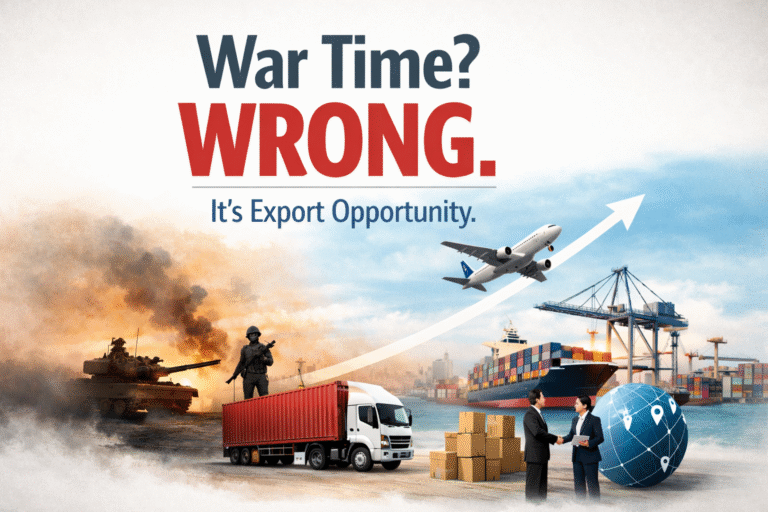
War Time Wrong — It’s Export Opportunity
War Time Wrong — It's Export Opportunity- For India
When war breaks out anywhere in the world, most people see destruction, uncertainty, and economic fear. Smart exporters see something else entirely — opportunity.
History has proven repeatedly that every major global conflict disrupts existing supply chains, shifts trade routes, and creates urgent new demand that someone has to fill. And in most cases, India is uniquely and perfectly positioned to be that someone.
The Russia-Ukraine war created massive demand for Indian wheat, pharmaceuticals, and engineering goods. The COVID pandemic made the entire world realize how dangerously dependent they were on single-source supply chains — and India stepped in as a reliable alternative. Today, the escalating tensions between Iran, Israel, and the United States are once again reshaping global trade flows — and once again, Indian exporters who are paying attention stand to benefit enormously.
At Exim Elite Pune, we help Indian exporters identify exactly where these opportunities are emerging — using real trade data, verified buyer intelligence, and market insights that turn global uncertainty into concrete business growth.
How Does War Affect International Trade?
To understand the opportunity, you must first understand the disruption.
War and geopolitical conflict impact international trade across multiple dimensions simultaneously — and understanding each one is essential for any exporter who wants to respond strategically rather than reactively.
Supply Chain Disruptions
When conflict breaks out in or near major manufacturing or agricultural regions, existing supply chains break down rapidly. Countries that previously sourced goods from conflict zones suddenly need alternative suppliers — urgently and at scale.
This is where Indian exporters historically step in. India’s manufacturing base, agricultural diversity, pharmaceutical capacity, and engineering capabilities make it one of the world’s most versatile alternative suppliers.
Shipping Route Disruptions
Wars near critical maritime chokepoints — like the Strait of Hormuz near Iran, or the Red Sea near Yemen — force shipping companies to reroute vessels through longer, more expensive paths. This increases shipping costs globally but also creates new competitive advantages for geographically well-positioned exporters.
India’s location on the Arabian Sea gives it direct access to Oman, UAE, and Saudi Arabia without passing through conflict zones — making Indian exports significantly more attractive and cost-competitive during Middle Eastern conflicts.
Commodity Price Spikes
Wars drive up commodity prices rapidly — particularly oil, gas, food, and metals. For India, which exports significant volumes of agricultural products, pharmaceuticals, and manufactured goods, rising commodity prices in conflict regions translate directly into increased demand for Indian exports as buyers seek stable, affordable alternatives.
Currency and Economic Volatility
Conflict zones experience currency devaluation and economic instability. Countries near conflict areas accelerate their search for stable trade partners — and India’s growing reputation as a reliable, high-quality supplier makes it an increasingly preferred destination for long-term trade relationships.
Will the Iran-US War Affect Export Business in India?
The escalating tensions between Iran and the United States represent one of the most significant geopolitical developments affecting global trade today — and the impact on Indian export business is both real and multidimensional.
The Risks Indian Exporters Must Acknowledge
An Iran-US conflict would likely disrupt shipping through the Strait of Hormuz — one of the world’s most critical maritime chokepoints through which approximately 20% of global oil trade passes. This would drive up shipping costs, increase oil prices, and create short-term volatility in India’s import bill.
Indian exporters to the Gulf region would need to adapt their logistics strategies — though India’s direct sea routes to Oman and the broader Gulf remain far less disrupted than routes serving Europe or East Asia.
The Export Opportunities That Emerge
However, the same conflict that creates these challenges simultaneously opens significant export doors for India:
Food and Agricultural Exports — Gulf nations that import 90% of their food would intensify their reliance on India as their nearest, most reliable, and most accessible food supplier. India already supplies 50-60% of UAE’s rice — this percentage would grow substantially under conflict conditions.
Pharmaceutical Exports — Conflict disrupts medicine supply chains rapidly. India’s position as the world’s pharmacy makes it the natural beneficiary of pharmaceutical supply gaps created by Middle Eastern instability.
Engineering and Industrial Goods — Post-conflict reconstruction creates massive demand for machinery, tools, and industrial equipment — sectors where India has growing export capability.
For Indian exporters ready to act strategically, understanding which buyers in the Gulf are already importing Indian products — and at what volumes — is the critical first step. Exim Elite Pune’s trade data analytics platform gives exporters exactly this intelligence — in real time.
Iran-Israel War Impact on Indian Economy
The Iran-Israel conflict carries specific and significant implications for the Indian economy — both as risks to manage and as opportunities to capture.
Impact on India’s Import Side
Crude Oil Prices — Iran is a major global oil producer. Any escalation that restricts Iranian oil supply drives crude prices higher globally — directly impacting India’s oil import bill, which already accounts for a significant portion of India’s trade deficit.
Shipping Costs — Conflict near the Strait of Hormuz and the Red Sea increases insurance premiums and routing costs for vessels, raising the cost of imports across multiple categories.
Inflation Pressure — Higher oil and commodity prices filter through the Indian economy as inflationary pressure — affecting manufacturing costs and domestic consumption.
Impact on India’s Export Side
Despite these import-side pressures, the Iran-Israel conflict creates substantial export opportunities for Indian businesses:
Middle East Food Security — As we analyzed in the Exim Elite content on India-UAE trade relationships, Gulf nations are acutely aware of their food security vulnerability. Conflict accelerates their urgency to secure long-term food supply agreements with India.
Pharmaceutical Demand — Israel is a significant importer of generic pharmaceuticals. Supply chain disruptions during conflict create immediate demand for Indian pharmaceutical exports.
Textile and Consumer Goods — Conflict-driven economic disruption in the region creates demand for affordable, quality consumer goods — a category where Indian exporters are highly competitive.
IT and Technology Services — Israel’s technology sector, while resilient, relies on global service partnerships. Indian IT exporters are well-positioned to support technology continuity during conflict periods.
The net effect of the Iran-Israel conflict on the Indian economy is complex — but for well-prepared exporters with access to real trade data and verified buyer intelligence, the opportunities significantly outweigh the risks.
War Time Is Not Wrong — It Is India’s Biggest Export Opportunity
This is the most important insight any Indian exporter can internalize — and the one that separates businesses that grow during global uncertainty from those that retreat.
India’s Historical Track Record
Every major global disruption of the past decade has ultimately strengthened India’s position as a global exporter:
Russia-Ukraine War (2022) — India became a critical wheat and sunflower oil alternative supplier to dozens of countries. Indian pharmaceutical exports to Eastern Europe surged. Engineering goods demand from reconstruction markets grew significantly.
COVID-19 Pandemic (2020-2021) — India supplied vaccines, pharmaceuticals, and medical equipment to over 150 countries. The pandemic permanently elevated India’s status as a trusted global health supply partner.
US-China Trade War — Manufacturing companies began diversifying supply chains away from China — with India emerging as one of the primary beneficiaries of this shift in electronics, textiles, and industrial components.
Why India Is Uniquely Positioned
India’s export opportunity during wartime is not accidental — it is structural:
- India is the world’s largest democracy with stable governance
- India has diplomatic relationships with virtually every country including conflict parties
- India’s geographic position provides direct access to the Middle East, Africa, and Southeast Asia
- India’s manufacturing base covers pharmaceuticals, agriculture, textiles, engineering, and technology
- India’s cost competitiveness makes it a preferred alternative supplier in price-sensitive markets
How to Capture War Time Export Opportunities
Recognizing the opportunity is the first step. Capturing it requires speed, intelligence, and the right tools.
Identify Which Markets Are Facing Supply Gaps Use trade data to identify which countries are experiencing import disruptions in your product category — these are your highest-priority target markets.
Find Buyers Who Are Already Importing From India Buyers who have existing relationships with Indian exporters are far easier to convert than those approaching India for the first time. Trade data reveals exactly who these buyers are.
Move Faster Than Your Competitors War time opportunities are time-sensitive. Exporters who act on emerging demand signals first capture the most valuable buyer relationships.
Position India’s Reliability as Your Competitive Advantage In uncertain times, buyers prioritize reliability over price. India’s track record as a stable, high-quality supplier is your most powerful selling point.
At Exim Elite Pune, our platform gives Indian exporters the real-time trade intelligence they need to identify these opportunities, find verified buyers, and act with confidence — before competitors even realize the window has opened.
FAQ
Q1. Will the Iran-US war affect export business in India? Yes — but the impact is two-sided. While shipping cost increases and oil price rises present challenges, Indian exporters stand to benefit significantly from increased demand for food, pharmaceuticals, and manufactured goods from Gulf nations seeking stable alternative suppliers.
Q2. How does war affect international trade? War disrupts supply chains, reroutes shipping, spikes commodity prices, and creates urgent new demand. For well-positioned exporters like those in India, these disruptions consistently create significant new export opportunities.
Q3. Is war time an export opportunity for India? Absolutely. India’s geographic position, manufacturing diversity, diplomatic neutrality, and cost competitiveness make it one of the world’s most effective beneficiaries of war-driven trade disruptions — as proven during the Russia-Ukraine war, COVID pandemic, and US-China trade conflict.
Q4. What is the Iran-Israel war impact on Indian economy? The conflict raises oil import costs and shipping expenses for India. However, it simultaneously creates export opportunities in food security, pharmaceuticals, consumer goods, and technology services — with Gulf nations increasingly reliant on India as their most accessible and reliable trade partner.
Q5. How can Exim Elite Pune help exporters during geopolitical conflicts? Exim Elite Pune provides real-time trade data, verified buyer intelligence, and market insights that help Indian exporters identify emerging demand, find active buyers in affected regions, and move quickly to capture war time export opportunities before competitors.
Conclusion
War is never good for humanity. But for Indian exporters who are prepared, informed, and data-driven — geopolitical conflict consistently creates some of the most significant export opportunities available in global trade.
The Iran-US tensions, the Iran-Israel conflict, and the broader instability across the Middle East are not reasons to retreat from global trade — they are signals to advance strategically, with intelligence and confidence.
India has proven repeatedly that it can step into global supply gaps and deliver. The question is not whether the opportunity exists — it absolutely does. The question is whether your business is positioned to capture it.
Exim Elite Pune gives you the trade data, verified buyer intelligence, and market insights to answer that question with a confident yes.